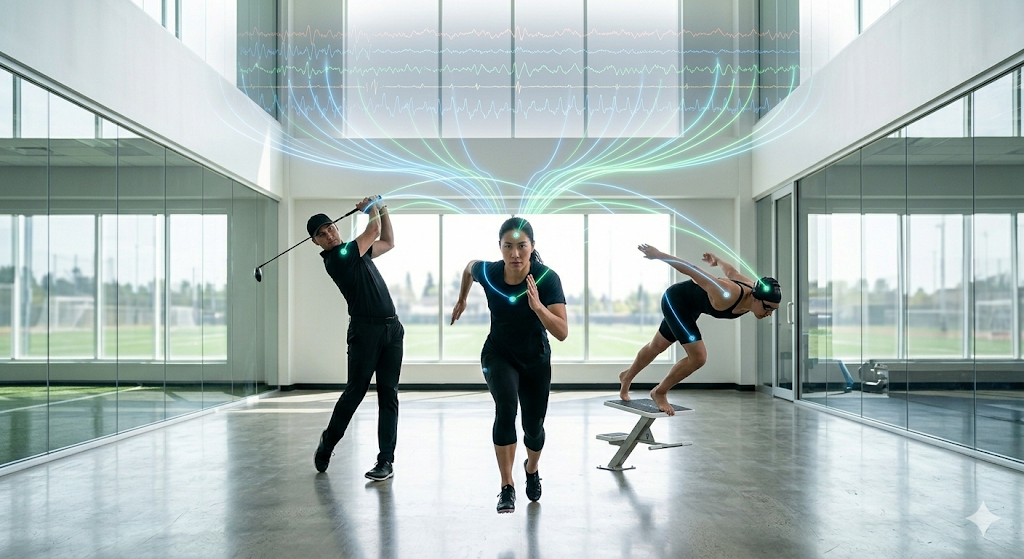
Every athlete knows the feeling: the moment your mind wanders, your body follows. A split-second lapse in concentration is the difference between hitting the target and missing wide, between holding your line and fading in the final set. Physical training gets you to the starting line. Mental focus is what determines where you finish.
The problem is that focus isn’t something most athletes train directly. You practice your shot, your stroke, your stride — but rarely do you practice the ability to sustain attention under pressure, recover from a mistake mid-competition, or quiet the noise when it matters most.
That’s changing. A growing body of research — including a 2025 Bayesian meta-analysis of 41 randomized controlled trials — shows that biofeedback and neurofeedback training produces measurable improvements in athletic performance, mental health, and cognitive function. And the technology to do it is no longer locked in sports psychology clinics.
What Is Biofeedback — and Why Should Athletes Care?
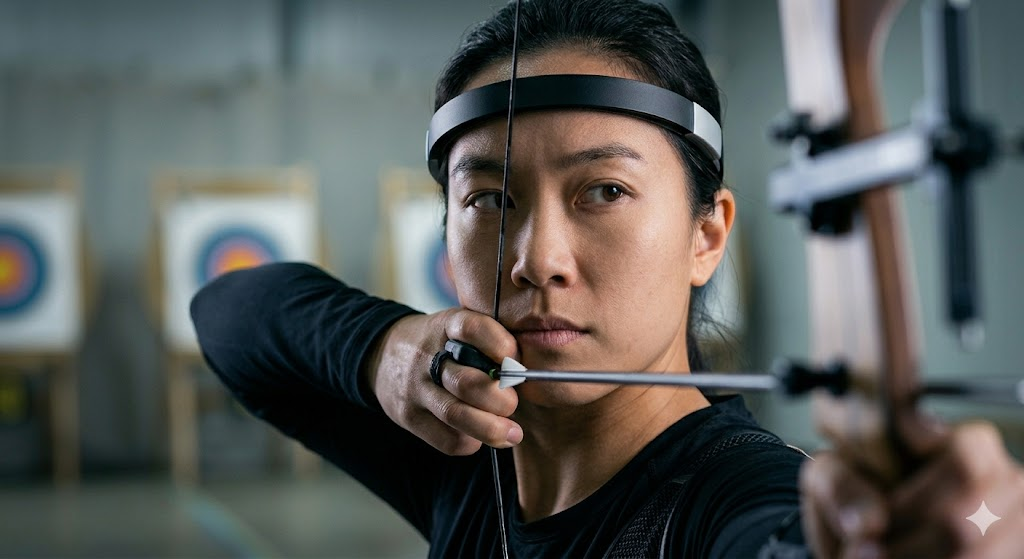
Biofeedback is simple in concept: sensors measure a physiological signal (brainwaves, heart rate, muscle tension), and a feedback mechanism shows you that signal in real time so you can learn to control it. Over time, your nervous system learns to self-regulate — producing the right state at the right moment without conscious effort.
For athletes, the relevant modalities are:
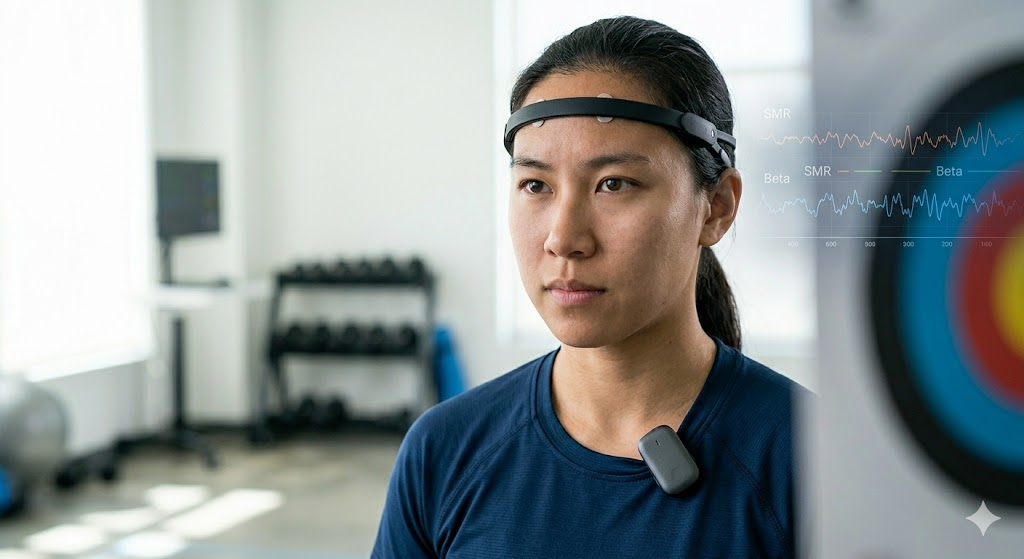
EEG neurofeedback — sensors on the scalp measure brainwave patterns associated with focus, relaxation, and arousal. Training specific frequency bands (like sensorimotor rhythm or alpha waves) has been shown to improve accuracy in precision sports like golf, archery, and rifle shooting, and to enhance reaction time and dynamic balance in combat sports and swimming.
HRV biofeedback — a chest strap or optical sensor measures heart rate variability, which reflects the balance between your sympathetic (“fight or flight”) and parasympathetic (“rest and recover”) nervous systems. HRV biofeedback training improves stress tolerance, emotional regulation, and recovery speed. A study on wrestlers found that HRV biofeedback significantly reduced reaction time compared to controls — and the improvement persisted at one-month follow-up.
EMG biofeedback — surface sensors measure muscle electrical activity. Used primarily in rehabilitation and injury prevention, EMG biofeedback helps athletes retrain muscle activation patterns after surgery and reduce excessive tension that impairs movement speed and flexibility.
What the Research Says: Biofeedback Works for Athletes
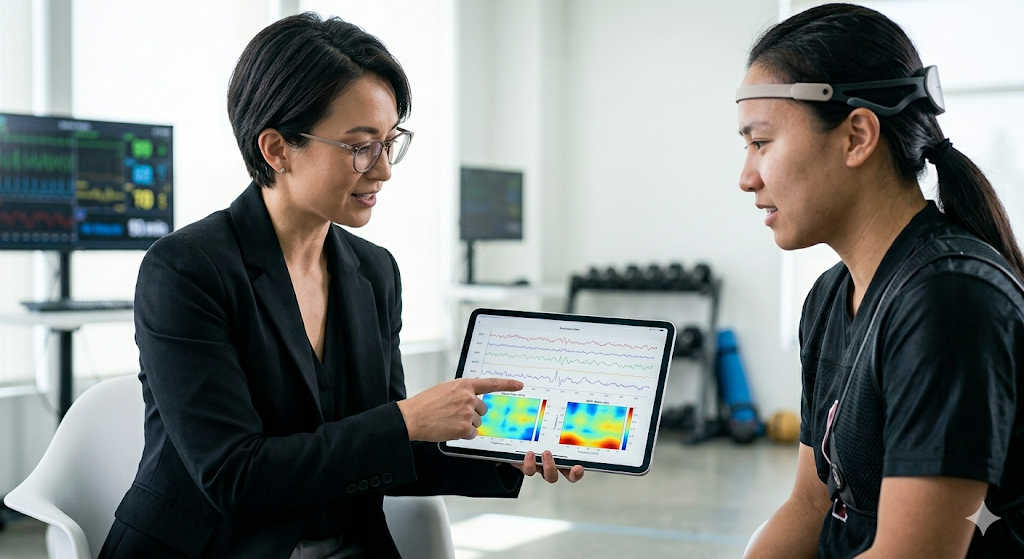
The evidence base has grown substantially. A 2025 systematic review and Bayesian meta-analysis published in Frontiers in Psychology analyzed 41 randomized controlled trials and found statistically significant improvements across all three domains tested: mental health (effect size 0.76), athletic performance (effect size 0.88), and cognitive performance (effect size 0.81).
Specific findings from the research literature include:
- Precision sports (golf, archery, shooting): Sensorimotor rhythm (SMR) neurofeedback training improved accuracy and consistency by helping athletes maintain the calm-but-alert state required for precise motor control.
- Combat and dynamic sports (judo, swimming, basketball): Beta wave neurofeedback enhanced dynamic balance, cognitive performance, and decision-making speed under pressure.
- Team sports (basketball, soccer, volleyball): HRV biofeedback reduced reaction time, improved concentration, and helped athletes maintain composure during high-pressure moments.
- Recovery and resilience: Biofeedback training enhanced parasympathetic nervous system activity, leading to faster physiological recovery between training sessions and competition.
The research also highlights that different sports benefit from different protocols — there’s no one-size-fits-all approach. An archer needs alpha wave training for visuospatial calm. A basketball point guard needs HRV coherence for split-second decision-making under crowd pressure. A golfer needs SMR training for the quiet mind required over a four-hour round.
How Elite Athletes Already Use Biofeedback
Biofeedback isn’t theoretical — it’s already embedded in elite sports performance programs. Professional athletes use neurofeedback to build the ability to enter “the zone” on demand, tuning out distractions during critical situations, increasing processing speed, and focusing energy on the task at hand.
The practical benefits athletes report include: smoother performance under pressure, improved recovery speed after an error (not dwelling on a missed shot), reduced “overthinking” in crucial moments, and better sleep quality — which directly impacts next-day performance.
Sports psychologists integrate biofeedback alongside traditional mental skills training like visualization, breathing techniques, and pre-performance routines. The difference is that biofeedback provides objective measurement — you can see whether your brain or heart is actually in the state you’re trying to achieve, rather than guessing.
5 Ways to Start Training Focus as an Athlete
1. Train HRV coherence daily
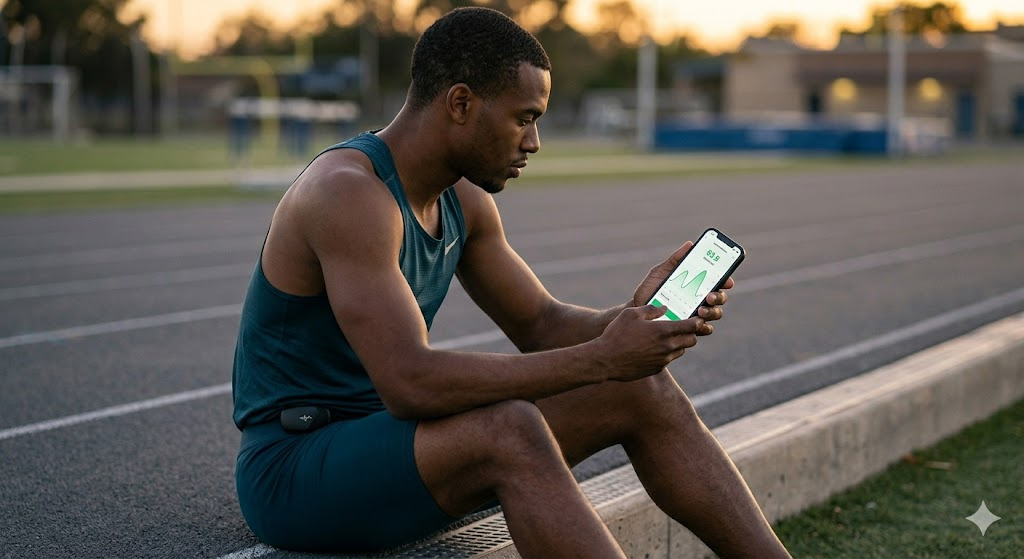
The simplest entry point. Use a chest strap (like the Polar H10) or an optical heart rate monitor, paired with an app that shows your HRV coherence score in real time. Practice resonance frequency breathing — typically around 6 breaths per minute — for 10-20 minutes daily. Research shows measurable improvements in stress tolerance and reaction time within two weeks.
2. Use neurofeedback for sport-specific brain training
Narbis smart glasses use EEG neurofeedback with a unique approach: the lenses tint when your focus drifts and clear when you concentrate. Unlike headband-based systems that require you to sit in front of a screen, Narbis glasses can be worn during actual training activities — reading playbooks, studying film, practicing visualization, or doing focused skill work. The feedback is ambient and continuous, which more closely mimics the sustained attention demands of competition.
3. Build a pre-performance routine backed by biometrics
Instead of guessing whether your breathing exercise is working, measure it. Use HRV or EEG monitoring during your warm-up routine and track whether you’re actually reaching your optimal arousal zone before competition. Over time, you’ll learn which combination of breathing, movement, and mental preparation reliably produces your best state.
4. Practice attention recovery, not just attention
Most focus training emphasizes sustaining concentration. But in sports, the critical skill is often how quickly you recover focus after a disruption — a bad call, a missed shot, a hostile crowd. Neurofeedback is uniquely suited for this because it provides immediate feedback when your attention breaks and rewards you for returning to a focused state. That recovery loop gets faster with practice.
5. Track your nervous system like you track your reps
Wearable HRV monitors can show you how your autonomic nervous system responds to training loads, travel, sleep disruptions, and competition stress over time. This data helps you identify when you’re trending toward overtraining or under-recovery before it shows up as a performance dip. The athletes who track this systematically gain an edge in periodization and readiness.
The Next Frontier: Biofeedback During Performance
The biggest limitation of current biofeedback tools is that most require you to sit still, close your eyes, or stare at a screen. That’s useful for dedicated training sessions, but it doesn’t match the reality of sports — where you need focus while moving, competing, and responding to unpredictable situations.
This is where the technology is heading. Narbis Edge, currently in development, integrates HRV coherence monitoring with the patented lens-tinting feedback system, designed specifically for athletes who need biofeedback during activity — not just before or after it. By connecting to external sensors like the Polar H10 for clinical-grade HRV data, Edge aims to bring real-time physiological coaching into training and warm-up routines without requiring a screen or interrupting the athlete’s workflow.
The goal is simple: if wearables like WHOOP and Garmin can tell you what happened to your body after the fact, the next generation of biofeedback wearables should help you optimize your state in the moment.
Conclusion
Focus isn’t a talent — it’s a trainable skill. The research is clear that biofeedback and neurofeedback produce real, measurable improvements in the cognitive and emotional skills that determine athletic performance: sustained attention, stress regulation, reaction time, and recovery from disruption.
You don’t need a $10,000 clinical setup or a sports psychologist on retainer to start. HRV coherence training with a $100 chest strap and a free app is a legitimate entry point. EEG neurofeedback through Narbis smart glasses offers a more targeted approach to attention training that works during everyday activities. And the next wave of wearable biofeedback — designed for use during actual athletic performance — is on its way.
The athletes who train their minds as systematically as they train their bodies will have the edge. That’s not a prediction — it’s what the data already shows.
Want to learn more about the science behind neurofeedback? Read our comprehensive guide to neurofeedback research. Ready to start training? Compare the best neurofeedback devices for 2026.